

Traditional Odishan Jewellery: History, Designs, Where to Buy
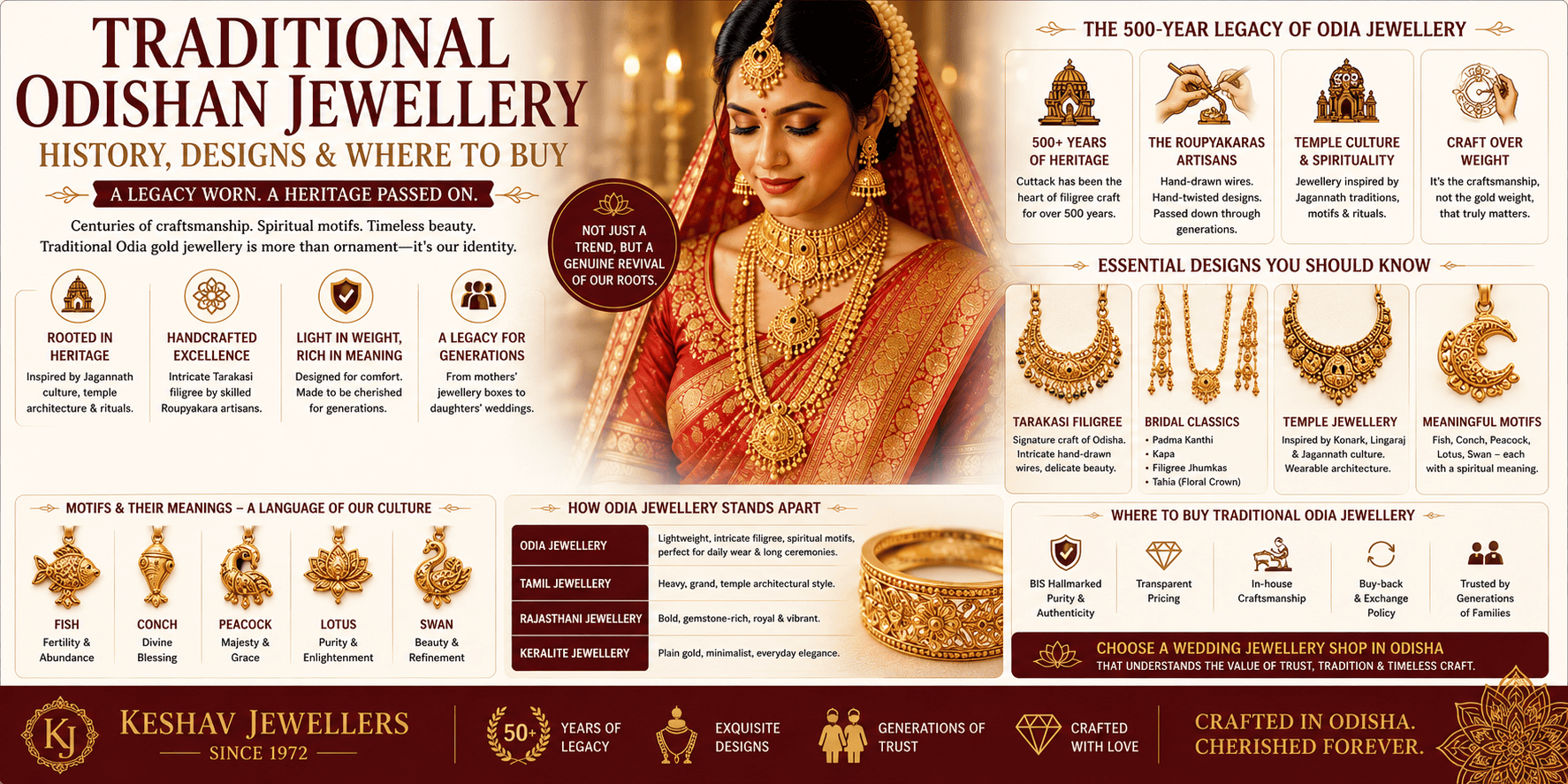
Something strange has been happening at Odia weddings lately. The brides are quietly going backwards—in the best way.
Mothers’ jewellery boxes are opening. Grandmothers’ almirahs are unlocking. Old Kapa sets no one had thought about in 15 years are coming out again. I noticed it first at a Cuttack wedding last winter and have spotted it at a dozen celebrations since.
Traditional Odia gold jewellery is experiencing a real comeback. Not a trend cycle. A genuine revival. This isn’t nostalgia. It’s recognition. Younger brides are discovering what their grandmothers always knew: that traditional Odia jewellery offers something different. Something quieter. Something that actually lasts.
A Brief History
Quick answer first:
Traditional Odia gold jewellery is a centuries-old craft from Odisha, built around three core elements:
- Tarakasi filigree (hand-drawn wire work)
- Temple-inspired forms (rooted in Jagannath culture)
- Bridal classics (shaped by royal patronage and ritual tradition)
The defining characteristic? Pieces are deliberately light. Motifs carry spiritual meaning. The craftsmanship, not the gold weight is what you actually pay for! Most outsiders get that backwards. It’s the whole point.
The 500-Year Legacy: How Cuttack Became the Home of Odia Filigree
Cuttack has been the centre of this work for at least 500 years. Probably longer. The records get hazy past that point.
The journey:
Mughal patrons funded its early refinement during the 16th-17th centuries. Princely households across coastal Odisha kept the workshops running after them—while plenty of other regional crafts in India were quietly disappearing.
Traditional Odia gold jewellery survived because the people making it never stopped.
The Artisans: Meet the Roupyakaras
The craftspeople are called Roupyakaras.
They hand-draw gold and silver into wires thinner than a strand of hair. They twist those wires into petals, paisleys, and birds. They solder every single joint by eye. No jigs. No templates. Just knowledge passed through hands for generations.
Temple Culture: The Spiritual Layer
Temple rituals shaped everything about traditional Odia gold jewellery beyond just aesthetics.
Rituals around Lord Jagannath in Puri determined:
- The motifs used
- The ornament shapes
- The way an Odia bride is dressed for bandhachuda (the wedding ceremony)
A piece that looks like decoration to an outsider is often devotional language worn on the body. Most of this sacred knowledge never made it to paper. It still lives in the hands of artisans.
The Essential Designs: What You Need to Know About Traditional Odia Gold Jewellery
1. Tarakasi Filigree: The Signature Craft
This is the headline.
Tarakasi is the filigree jewellery Odisha is internationally recognised for. It’s what defines the entire category.
The work involves:
- Wires finer than embroidery thread
- Hand-twisted florals, paisleys, and peacocks
- Individual joints soldered by eye
A serious Tarakasi piece takes 2-3 weeks of skilled labour. Cheap imitations come off a stamping die in under an hour.
How to spot authentic Tarakasi filigree: Flip the piece over. Hand-soldering shows tiny, visible irregularities. Die-stamped work is too perfect to be human. If it’s flawless, it’s machine-made.
2. Bridal Classics: The Traditional Odia Gold Jewellery Wedding Set
Odia bridal gold jewellery doesn’t arrive in one big statement. It builds slowly. You only notice the full effect once everything is on.
The essential pieces:
- Padma Kanthi — The lotus-shaped neckpiece, symbolic of purity
- Kapa — Pendant with hanging gold beads worn in strands
- Filigree Jhumkas — Earrings built on intricate filigree backings
- Tahia — The towering white floral crown threaded with gold, worn during the bandhachuda (wedding) ceremony
Each piece serves both aesthetic and spiritual purposes in traditional Odia ceremonies.
3. Temple Jewellery Odisha: Wearable Architecture
Temple jewellery from Odisha is architectural, sculptural, and religiously significant.
Design elements include:
- Borders mimicking Konark and Lingaraj temples
- Sun motifs drawn straight from temple walls
- Dense symbolic carving throughout
A serious temple necklace sits closer to a wearable shrine than to any piece you’d call everyday fashion.
4. Motifs and Their Meanings: The Language of Traditional Odia Design
The same motifs keep appearing across traditional Odia jewellery designs in countless variations:
Motif | Meaning |
Fish | Fertility and abundance |
Conch | Divine blessing |
Peacock | Majesty and grace |
Lotus | Purity and enlightenment |
Swan | Beauty and refinement |
These symbols carry cultural and spiritual weight. They’re not decoration—they’re language worn on the body.
How Traditional Odia Gold Jewellery Differs From Other Regional Styles
Set traditional Odia gold jewellery next to its neighbours and the difference is obvious within seconds.
Regional comparison:
- Tamil temple jewellery — Heavy, architectural, grand
- Rajasthani Kundan — Gemstone-focused, elaborate settings
- Bengali gold — Bold sculptural forms, dramatic presence
- Odia traditional jewellery — Whispers rather than shouts
The core difference?
Craftsmanship is the headline. Gold weight is not.
Why Younger Brides Are Choosing Traditional Odia Gold Jewellery
That whisper is exactly why younger brides keep coming back to traditional Odia gold jewellery.
Most of us, frankly, are tired of jewellery that shouts.
The appeal:
- Quieter, more sophisticated aesthetic
- Lightweight enough to actually wear all day
- Works with modern wardrobes as easily as traditional ones
- Investment pieces that gain value through history and craftsmanship
Traditional Odia Gold Jewellery in Modern Bridal Fashion
The styling shift is what I find most interesting.
The New Bridal Aesthetic
Brides today aren’t stacking 12 necklaces anymore. The traditional approach has evolved:
Modern bridal styling with traditional Odia gold jewellery:
- Pick one Tarakasi choker, pair it with a clean handloom saree, and stop
- Wear a temple set with a contemporary blouse cut
- Throw grandmother’s Kapa over a pastel lehenga, skip the maang tikka entirely
- Layer a single filigree pendant with a minimalist blouse
The look is quieter. More confident. Somehow more bridal than the heavy version ever was.
Beyond Weddings: Odia Filigree Goes Mainstream
Mumbai stylists have started noticing too.
You’ll spot traditional Odia gold jewellery at film premieres now, worn by people with no connection to Odisha who simply recognise quality craftsmanship when they see it.
Why it works in modern wardrobes:
- Lightweight enough for everyday wear
- Photographs beautifully (social media friendly)
- Works equally well with sarees, lehengas, fusion wear, and contemporary clothing
- Gains conversation value through its heritage story
The trick? Wear it lightly. Let the craft speak for itself.
Buying Guide: How to Choose Authentic Traditional Odia Gold Jewellery
Most first-time buyers make the same predictable mistakes. Here’s how to avoid them.
Mistake #1: Obsessing Over Weight
The Problem: Many buyers assume heavier = better quality. Not true for traditional Odia gold jewellery.
The Truth: Tarakasi filigree is meant to be light. The entire craft is built around thin, hand-drawn wire and dense detailing.
Red flags:
- If a filigree set feels heavy in your hand, it’s either machine-made or padded with solid metal underneath
- Authentic Tarakasi should feel delicate, almost fragile
Pro tip: Compare the weight of similar pieces. Authentic filigree will always feel lighter than you expect.
Mistake #2: Skipping the Hallmark Conversation
Always ask about hallmarking. Don’t assume.
Reputable Odisha jewellers should offer:
- BIS hallmarking (Bureau of Indian Standards certification)
- Itemised making charges (not buried in total price)
Why filigree costs more: Filigree making charges run higher than standard gold work because the labour genuinely is higher. The artisan spends 2-3 weeks on a single serious piece. Pay the fair price. It’s justified.
What to ask:
- “Is this BIS-hallmarked?”
- “What are your itemised making charges?”
- “How long did this piece take to create?”
- “Who made this piece? Can I know the artisan’s name?”
Mistake #3: Buying Occasion-Only Pieces
The Regret Cycle: You buy a gorgeous Tahia for your wedding day. You wear it once. Two years later, it sits in your locker.
The Better Approach:
- A wedding-day Tahia is glorious for one evening
- A Tarakasi pendant lasts 40 years, works with multiple outfits, and grows in value
Buy at least one heirloom piece alongside occasion-specific items. Same shopping trip, ideally. This ensures you’ll actually wear—and treasure—your investment.
Mistake #4: Ignoring Fit and Proportion
The Challenge: Filigree photographs very differently than it wears on your body.
Always try the piece on:
- Walk around the showroom
- Sit down and check movement
- Look in a full-length mirror
- Assess whether it suits your face shape and existing wardrobe
A piece that photographs beautifully might feel overwhelming in person, or too delicate for your frame. Fit matters.
Where to Buy Authentic Traditional Odia Gold Jewellery
In Odisha: The Two Best Locations
Cuttack: The Artisan Hub (Best for Authenticity)
Cuttack is always the first choice. Always.
The lanes around Naya Sarak and Balu Bazaar still hold tiny workshops where artisans bend over wires under yellow tube lights, doing exactly what their grandfathers did. You’ll see the craft happening in real-time.
Why visit Cuttack:
- Direct access to working artisans
- Most competitive pricing
- Widest selection of traditional styles
- Can commission custom pieces and meet the maker
- Authentic, unpolished shopping experience
Bhubaneswar: The Retail Experience (Best for Convenience)
Bhubaneswar offers a more polished retail experience, with showrooms that feel like ateliers rather than shops.
Why visit Bhubaneswar:
- More accessible location
- Professional, curated selections
- Comfortable shopping environment
- Professional after-sales service
- Easier if you’re travelling from outside Odisha
The Golden Rule: Choose a House With Lineage
When figuring out where to buy traditional jewellery in Odisha, the rule is simple:
Pick a jeweller with lineage and heritage.
Ask these questions:
- Who makes the pieces?
- Where are they made?
- How long does each piece take?
- Can they provide the artisan’s name?
- Do they have BIS hallmarking certificates?
Walk away from anyone who cannot answer these questions directly.
Recommended: Keshav Jewellers and Similar Legacy Brands
Legacy names like Keshav Jewellers fit this profile and are worth visiting in person.
Why Keshav Jewellers stands out:
- Known across Odisha for preserving traditional craftsmanship
- Gently updated designs for younger brides (without compromising authenticity)
- Transparent about makers and timelines
- Strong reputation for quality and fair pricing
Similar jewellers worth researching:
- Ask locals for recommendations during your Cuttack visit
- Look for showrooms with decades (or generations) of history
- Check for online reviews mentioning craft authenticity
Online vs. In-Person: When to Use Each
Online works for:
- Smaller pieces (earrings, pendants, rings)
- Reorders from trusted jewellers
- Research and education
- Browsing collections before you visit
Go in person for:
- Heirloom sets (chokers, temple sets, complete bridal collections)
- First-time purchases
- Custom commissions
- Proper authentication and fitting
You will not regret the trip. Seeing the craft and meeting the maker transforms how you wear the jewellery.
Common Mistakes When Buying Traditional Odia Gold Jewellery
Here are the mistakes that keep recurring in showroom conversations—and how to avoid them.
Mistake: Trusting Price Alone:
A high price does not guarantee authentic traditional Odia gold jewellery. A low price almost always confirms its absence.
What to do instead: Ask about the maker, the time invested, and the specific techniques used. Price should reflect labour and craft, not just gold weight.
Mistake: Mistaking Machine Filigree for Handwork
Machine-made filigree has become increasingly convincing. Don’t be fooled.
Your test: Flip the piece over. Authentic traditional Odia gold jewellery shows:
- Tiny irregularities from hand soldering
- Visible tool marks
- Subtle variations in wire thickness
Machine work is too perfect to be human.
Mistake: Rushing the Timeline
A custom Tarakasi commission takes 4 to 6 weeks minimum.
If a jeweller promises a complex piece in 72 hours, something is off. Authentic craftsmanship cannot be rushed.
Mistake: Skipping Documentation
Get:
- The certificate (BIS hallmark)
- The receipt (with itemised charges)
- The artisan’s name (if possible)
Why this matters: Heirlooms travel across generations. Provenance—the documented story of who made it and when—is what gives traditional Odia gold jewellery value beyond the daily gold rate.
Conclusion: The Future of Traditional Odia Gold Jewellery
Honestly, traditional Odia gold jewellery is not really about jewellery anymore. It’s about a craft that survived empires, market crashes, and several waves of mass production. And somehow kept its hands steady through all of it.
To wear a Tarakasi piece is to carry that quiet survival on your collarbone. To buy one well is to extend its life by one more generation.
The revival is real. Better still, the craft—quietly—never stopped.